
Overview
Below is Lane's planning and institutional effectiveness model, which is "under construction" and will emerge as the integrated planning framework. This page also links to the Economic Impact Study, Program Demand Gap Analysis, and the Horizon Scan resources, including infographics created by Linh My Ta, Communication and Data Specialist student worker.
In May 2023, we began developing an integrated planning framework, which will take approximately 36 months to fully implement. In 2023/2024, we collated all institutional goals, tested software systems, and more effectively tracked Strategic Plan goal achievement. In 2024/2025 we tested and improved the annual planning process, aligned data gathering language, and began to connect planning and resource allocation. In 2025/2026, we pulled academic and administrative program review recommendations into the annual planning process. In 2026/2027, we will continue to hone systems based on user feedback.
Lane's planning furthers the Lane's mission and forms the basis for regular and effective assessment, improvement, and adaptation.
Strategic Plan goals and objectives are established every five years. They identify priority actions needed to achieve Lane’s mission, as measured by Mission Fulfillment Indicators. In 2026/2027, we will begin the new Strategic Planning process.
Program review and department planning support strategic goals and objectives by operationalizing priorities and improvements at the program and service level.
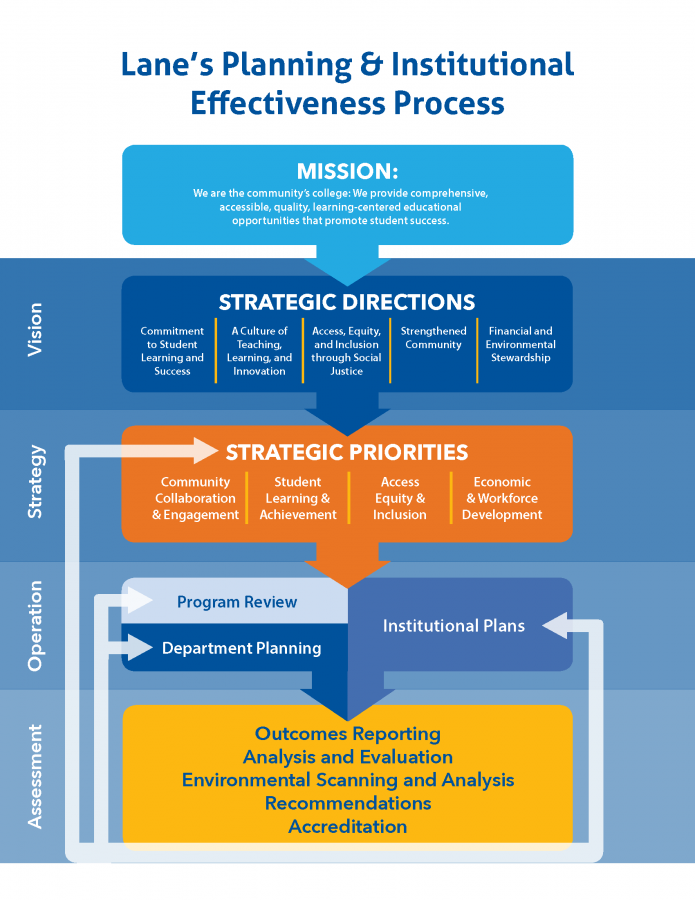
Process and Principles
Planning and effectiveness is an ongoing process of improvement that leads to the achievement of program, department, division, and institutional goals and fulfillment of our mission. Below are some of the assessment practices at Lane. Learn more about College Initiatives here.
Student Learning Assessment
Program and Service Level Assessment
Program Review
Annual Department Planning
Institutional Assessment
Mission Fulfillment
Accreditation Self Study
Key Tenets
Comprehensive, Integrated, and Ongoing Planning
There is consistent and continuous commitment to improving student learning. Educational effectiveness is a demonstrable priority in all planning structures and processes.
Informed by Data and Analysis
Data and analyses are widely distributed, understood, and used throughout the College.
Broad-Based Participation and Engagement
There is dialogue about planning and institutional effectiveness that is ongoing, robust, and pervasive.
Implementation, Evaluation, and Adaptation
There is ongoing, systematic review and adaptation of evaluation and planning processes. The College uses evaluation and planning to refine its key processes and improve student learning.
Planning Guides Resource Allocation
Formal planning and assessment practices guide resource allocation. The College effectively uses its human, physical, technology, and financial resources to achieve its broad educational purposes, including stated learning outcomes.
Resources
The following reports help stakeholders make evidence-informed decisions.
Economic Impact Study
Lane has considerable impact on the local economy. The most recent Lightcast report from 2023-24, found that:
- Lane added $816.2 million to the region's income and contributed to 9,787 jobs
- Society gains $5.30 in added income and social savings for each dollar invested in Lane
For every $1 students invest in their education at Lane they receive an additional $4.00 in lifetime earnings, providing them with an average annual rate of return of 14.5%.
Read the About Lane webpage and the links below to learn how the college and its students make a difference.
Fact Sheet | Executive Summary | Main Report | Infographic
The previous studies are below. Please note that multiple years of reports are not intended to be compared due to changes in the Lightcast methodology and the service area.
2021-22 report links:
2018-20 report links:
Program Demand Gap Analysis
The Program Demand Gap Analysis is based on Lane County and LCC data. It compares job openings and LCC educational program completions to identify opportunities to consider.
Horizon Scan
The LCC Environmental Scan Report 2022 reveals trends that are likely to impact Lane in the next 2-3 years. The in-depth report includes economic, social, political, environmental and more. Linh My Ta, Communication and Data Specialist student worker during 2022, created multiple infographics below. LCC employees may view additional resources here.
Contact Planning and Institutional Effectiveness
Planning and Institutional Effectiveness
4000 East 30th Avenue
Eugene, OR 97405
Keith Comer, Director of Institutional Research & Effectiveness
comerk@lanecc.edu | (541) 463-5315
Tammie Stark, Project Manager
starkt@lanecc.edu | (541) 463-3257