
In her time leading Lane’s Academic and Tutoring Services through the COVID-19 pandemic, Casey Reid helped many students, but quickly saw an unaddressed need. “I found that what students needed to be successful,” Reid explains, ”was less academic preparation, and more overall support in other aspects of their lives.”
That seed of thought, an idea of more wellness support, stayed with Reid as her career evolved and her passion for mental health education grew. She still teaches part-time at Lane, but has also taken on an exciting new role, as Lane Education Service District's Behavioral Health Pathway Specialist. Managing three grants of over $1.3 million, she’s created an exciting new Career Technical Education (CTE) program for high school juniors and seniors to explore careers in behavioral health.
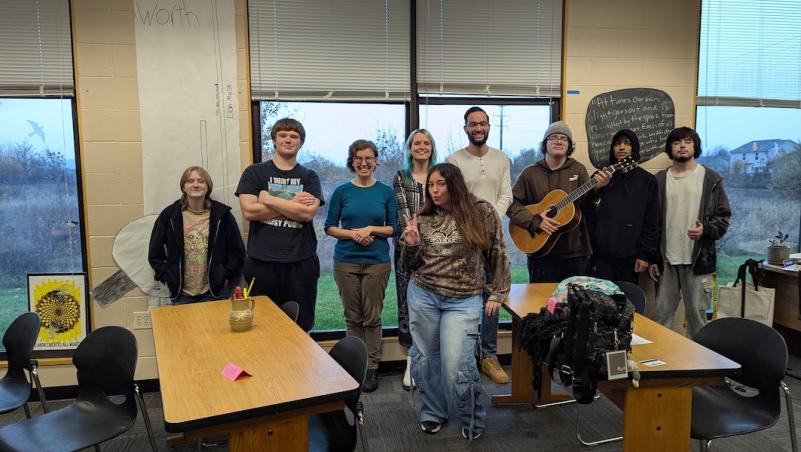
In this pilot year, the new CTE program teaches students Teen Mental Health First Aid, deescalation training, suicide prevention and intervention (like Sources of Strength and Question, Persuade, Refer), and even CPR (Cardiopulmonary Resuscitation). There is currently an online cohort across Lane County, and in-person classes at Creswell, Siuslaw, Mapleton, and Kalapuya High Schools, with plans to expand in the coming year. Students say they’re already learning valuable life skills they can start using right away.
“The program has helped me understand what Behavioral Health is, what I might want to do, and how it’s involved in any career,” says Neha Rimal, a student at Churchill High School. “It also teaches you how to regulate yourself and others.”
Though students learn practical skills that apply to daily life and many careers, the program provides real world experience to help prepare them for a career in behavioral health, where there is great need. Much of the funding for the CTE program comes from Oregon Health Authority, which hopes to address the state’s critical shortage of mental health professionals. Reid adds the need is particularly acute for rural communities and for people of color or lower socioeconomic status, that even advances in telehealth have not been able to address. More training also means a more diverse pool of providers, like those who are bilingual or identify as LGBTQ.
Community shapes the CTE's pedagogy as well as its goals. The students studying behavioral health are partnering with Whitebird’s HOOTS (Helping Out Our Teens), implementing peer-support programs in schools, and job shadowing mental health providers. The high-schoolers also get to work with students from University of Oregon and Lane Community College and earn some college credit for their studies, earning credit towards programs like LCC’s new Qualified Mental Health Associate (QMHA) Program.
“Mental health and wellness is one of the issues of our time,” Reid says, “There’s a lot of need. And a lot that we can do with some education.”
Lane Community College educates over 17,000 students annually at six locations across Lane County and online. Students and alumni from all 50 states and 79 countries create more than an $675 million dollar impact on the local economy, helping to support more than 8,900 local jobs. Lane provides affordable, quality, professional technical and college transfer programs; business development and employee training; academic, language and life skills development; and lifelong personal development and enrichment courses.