
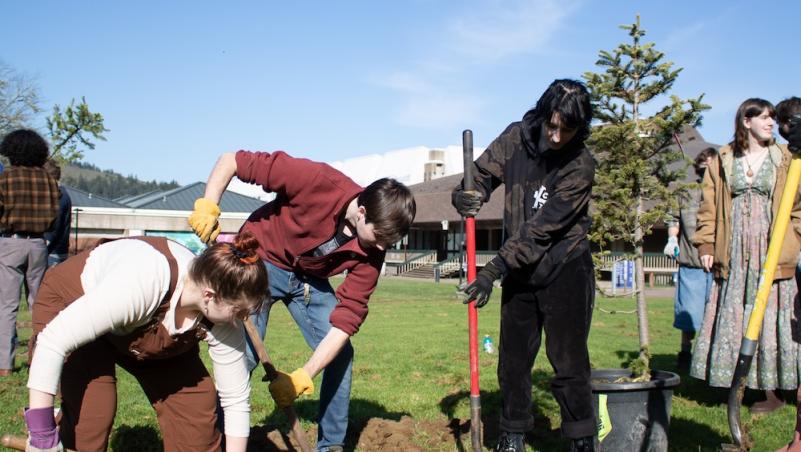
Lane is planting 47 new trees—and taking the next step toward becoming Eugene’s only official Tree Campus
Students now taking Biology 103: Forest Ecology may forget some things about Lane as their lives take them to new places and new careers, but they’ll never forget the time they helped plant a tree on campus.
This winter, Lane Community College began planting 47 trees as part of a bigger goal: becoming an Arbor Day Foundation–designated Tree Campus. If approved, Lane would be the only official Tree Campus in Eugene, joining a small group statewide. There are currently seven Tree Campuses in Oregon (six colleges and one K–12 school).
The project is also part of Lane’s growing commitment to campus sustainability. Lane became a certified Bee Campus in 2019, taking steps like planting native flowers and avoiding neonicotinoid pesticides. Applying for grants like these allows the college to continue working toward a campus with happy pollinators and healthy ecosystems while maintaining financial responsibility.
The Bees and the Trees
Lane’s new trees were made possible by an Arbor Day Foundation grant that funded about $2,500 in trees, plus two paid student Forest Steward positions to help plant them. The Forest Stewards, Jamari Crocker and Murilo Ballarin-Frateschi, are supervised by Andrea Mull, Lane’s Learning Garden Specialist.
Once the planting is complete, the Forest Stewards will continue supporting campus projects, including surveying trees across campus and helping Andrea plant a future “food forest” in the Learning Garden.
The grant application was led by Lane’s Sustainability Committee, including Colin Phifer (Biology Instructor), Luis Maggiori (Sustainability Coordinator), and Andrea Mull.
The new trees are being planted primarily in the south part of campus near Building 16, an area that’s currently more open and sparse. Over time, the new plantings are expected to help:
- Reduce the heat island effect (more shade, cooler walkways and outdoor spaces)
- Improve stormwater retention (healthier soils that hold water instead of shedding it)
- Add habitat and food sources for birds and other wildlife
- Carbon dioxide sequestration
The tree list includes a variety of species chosen for both ecological and learning goals. Some were selected because they are important to Oregon ecology but weren’t well represented on campus, like forest hemlock. Others connect to what students are learning in class, like tree evolution (represented by magnolia) and native Oregon ecology (represented by Garry oak and ponderosa pine).
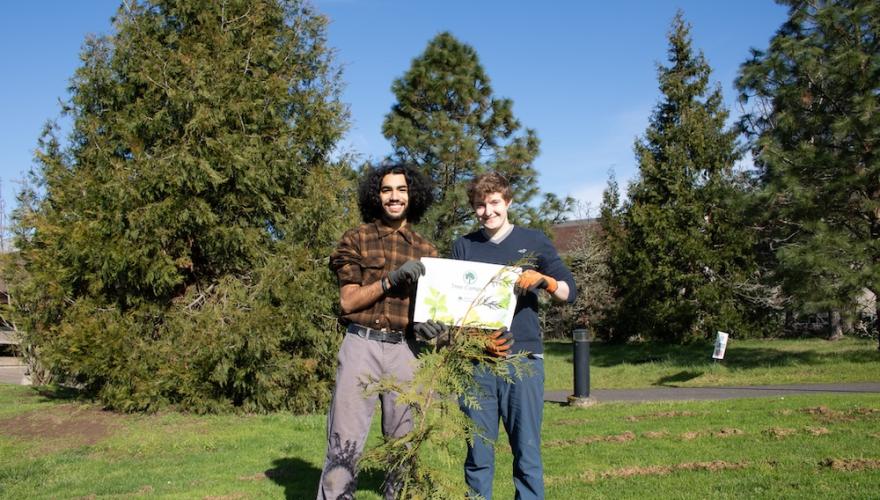
Hands-On, Dirt-Under-Fingernails Learning
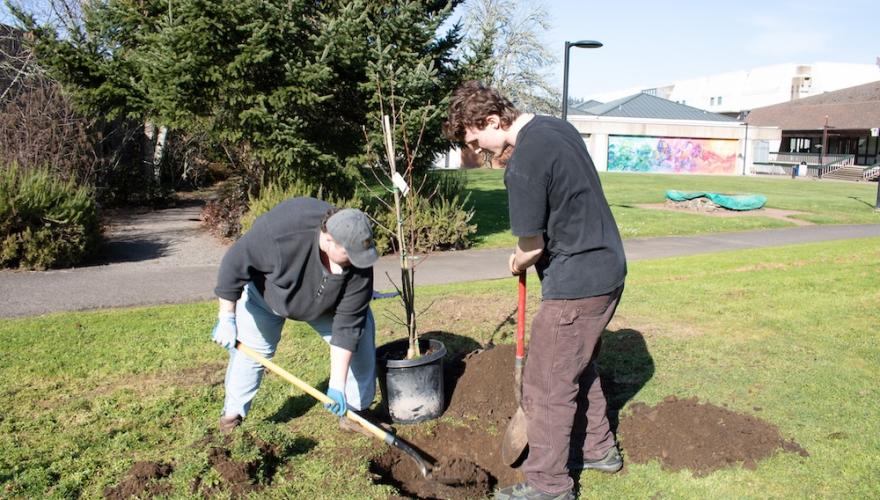
While most of the planting is being done by the Forest Stewards, other students are involved too. This term, Colin’s Forest Ecology students helped with planting as part of their coursework. Their learning didn’t stop at the shovel: students also wrote short “tree-o-graphies,” blending observation, ecology, and storytelling to understand what different species need to survive.
For Colin, that hands-on learning for his students is the heart of the project:
“Students learn better when they can touch it, see it, and be part of it. Planting trees isn’t just a lesson; it’s something they’ll remember. It makes ecology real.”
Colin also hopes the project grows beyond this single planting season.
“My hope is that this grant is a snowball. Once you start improving campus sustainability in a visible way, it’s easier for people to imagine what’s possible next.”
And for students who plan to transfer, the project also strengthens a connection to Oregon’s broader ecology and forestry community. Oregon State University kindly supported Lane during the Tree Campus application process by sharing campus planning resources. Future biology, ecology, and forestry students see the real connection between community college and their path to bachelors and graduate degrees.
Small Starts, Big Beginnings
Planting has already begun, and care will continue long after the last tree goes into the ground. The Forest Stewards will support early care in the first months, and then Facilities and Groundskeeping will take over long-term maintenance.
Meanwhile, Lane’s Sustainability Committee is working on the next step in the Tree Campus process: developing a Tree Campus Plan to guide future planting, care, and education.
For now, the change is already visible with new growth, just in time for spring. For students, it’s a future they can see and a tree they can revisit in 50 years, overseeing a new generation of science students with their own tree-o-graphies.
Lane Community College educates over 17,000 students annually at six locations across Lane County and online. Students and alumni from all 50 states and 79 countries create more than an $675 million dollar impact on the local economy, helping to support more than 8,900 local jobs. Lane provides affordable, quality, professional technical and college transfer programs; business development and employee training; academic, language and life skills development; and lifelong personal development and enrichment courses.